A small bathroom can be perfectly functional and still feel strangely disconnected from the rest of your home. You step inside, switch on a light that feels a little too harsh, move bottles aside to reach the sink, and tell yourself you will eventually make the room feel better. Perhaps you have already saved pastel bathrooms, antique mirrors, patterned tiles, and candlelit tubs to a Pinterest board. Yet those images often belong to rooms with generous vanities, tall ceilings, and enough floor space to make every styling decision look effortless. Real bathrooms are rarely that accommodating. They have narrow counters, awkward corners, visible plumbing, limited storage, and routines that leave behind damp towels, skincare bottles, bath toys, or an untidy row of everyday essentials. In a compact room, even a few misplaced objects can make the entire space feel unsettled. But a cozy bathroom retreat does not begin with more square footage, a freestanding tub, or a costly renovation. It begins with understanding what the room needs to feel calmer. Sometimes that means replacing visual noise with a more intentional arrangement. Sometimes it means letting one soft color create continuity instead of introducing several competing shades. A vintage-inspired mirror can bring character to an otherwise plain wall. A better place for daily products can restore breathing room around the sink. Warm light, clean textiles, and one quiet sensory detail can soften the final minutes of the day. The goal is not to disguise the fact that your bathroom is small. It is to make the room feel considered, comforting, and genuinely useful within the space it already has. Throughout this journal, we will build that transformation gradually. We will begin by identifying what makes a small bathroom feel crowded, then shape a gentle color story, introduce vintage character without creating clutter, organize the room around real routines, and finish with the small sensory details that turn an ordinary bathroom into a place you look forward to entering. Not a showroom. Not an unrealistic spa. Just a warmer, more beautiful version of the bathroom you use every day.
Start With What Makes the Bathroom Feel Crowded
Before choosing a wall color or bringing home a vintage mirror, spend a few ordinary minutes watching how your bathroom actually works.
Notice what lands on the counter after the morning rush. Look at where damp towels are left, which bottles are used every day, and which items are constantly moved from one place to another. Pay attention to the corners that gather things simply because they have never been given a better home.
This is where a small bathroom usually begins to feel crowded—not because it contains too much, but because too many objects are asking for attention at the same time.
A toothbrush beside a skincare jar may seem harmless. Add a hairbrush, a hand soap bottle, a candle, spare towels, makeup, and an open package of cotton pads, and the eye no longer knows where to rest. In a larger room, those details may disappear into the background. In a compact bathroom, they become the room.
The first transformation is not a shopping trip. It is an edit.
Begin by separating everything into three quiet categories: what you use every day, what you reach for occasionally, and what has simply remained visible out of habit. Daily essentials deserve the easiest access. Occasional products can move into a drawer, basket, cabinet, or shelf. Anything expired, duplicated, nearly empty, or no longer part of your routine can leave the room altogether.
This does not mean your counter needs to become completely bare. A bathroom should still feel human and usable. The goal is to reduce competing objects so the few things left in view feel intentional.
Try keeping only the items needed for the next part of your routine. Hand soap may stay beside the sink. Toothbrushes can remain within reach, but not necessarily scattered across the counter. Skincare used morning and night can be gathered into one small zone instead of forming a loose line around the basin.
A low-profile countertop tray can keep a few everyday essentials visually contained, preventing small bottles and jars from slowly spreading around the sink.
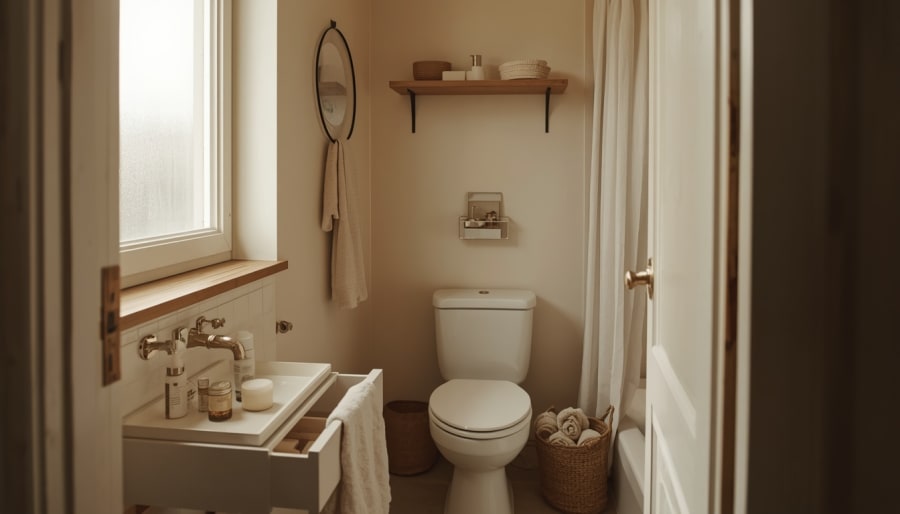
Then look upward.
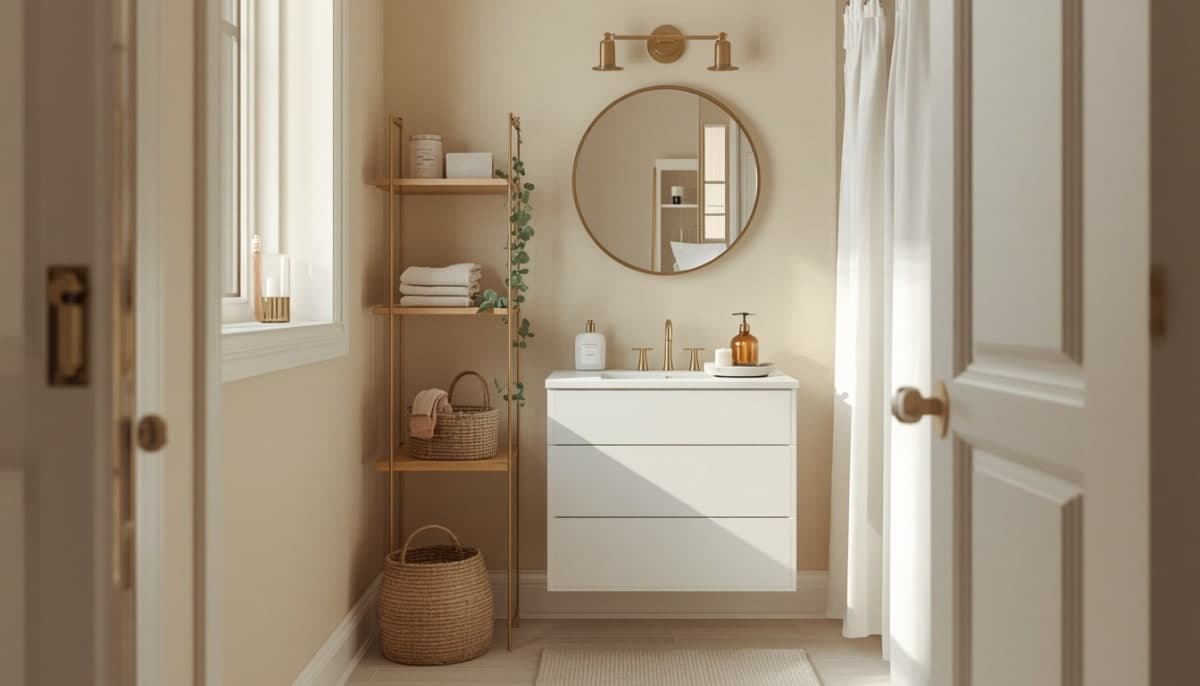
In many small bathrooms, the walls are underused while the sink and floor carry too much responsibility. A narrow shelf above the toilet, a discreet wall hook near the shower, or a slim cabinet can move necessary items away from the busiest surfaces. The solution is not to fill every wall. It is to give frequently used objects a predictable place close to where they are needed.
Finally, consider what the bathroom looks like when no one is using it.
Is the shower curtain fully closed or bunched to one side? Are towels folded, hung, or draped wherever they fit? Can you see several product labels from the doorway? Do open baskets reveal more clutter than they contain?
These small visual breaks matter because a compact room is often understood in a single glance. When that first glance feels calm, the bathroom immediately feels more spacious—even though nothing about its actual dimensions has changed.
This reset creates the foundation for every design choice that follows. Soft color will feel softer. Vintage details will feel more special. Warm lighting will have room to glow.
Before adding beauty, give the room somewhere to breathe.
Build a Soft Color Story, Not a Collection of Pastels
Pastel bathrooms often look effortless in photographs because the color feels quiet. What is less obvious is how carefully that quietness has been controlled.
A pale pink wall, soft green towel, powder-blue bath mat, floral shower curtain, and lavender storage basket may all be beautiful on their own. In one compact room, however, each new color creates another place for the eye to stop. Instead of feeling gentle, the bathroom begins to feel divided into small decorative moments.
The solution is not to avoid color. It is to give color a clear order.
Begin with one shade that will carry most of the room’s mood. This might be dusty blush, pale sage, softened blue, warm buttercream, or a muted peach. The best choice is usually not the brightest swatch you love on a screen, but the quieter version of it—the one that still feels comfortable in morning light and under an evening fixture.
Let that color appear across one meaningful surface rather than several unrelated accessories. A painted wall, a shower curtain, or a repeated textile tone can create continuity more effectively than small pastel objects scattered throughout the room.
Next, choose a warm neutral to give the palette somewhere to rest.
Cream, soft white, warm stone, oatmeal, and pale natural wood keep pastel color from becoming overly sweet. They also help everyday bathroom items—white sinks, toilet fixtures, folded towels, and storage containers—feel connected instead of visually separate.
Then add one restrained accent.
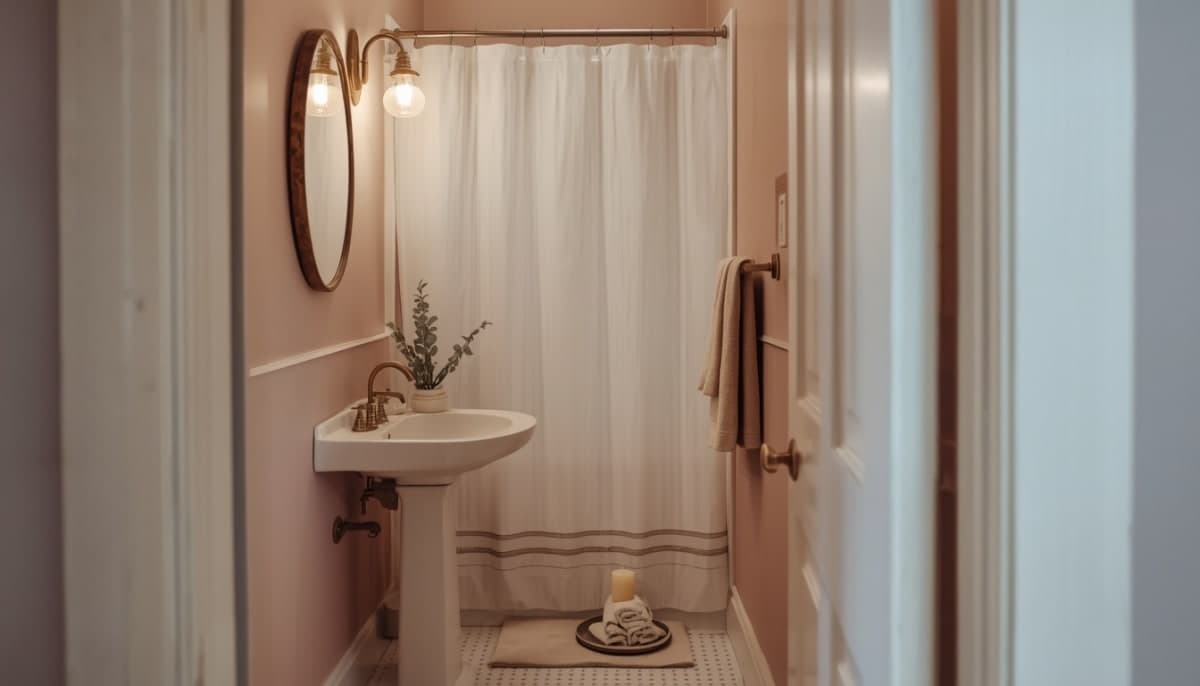
This is where vintage character can quietly enter. Aged brass, muted burgundy, dusty olive, faded terracotta, or a deeper version of the main pastel can give the room definition without interrupting its softness. The accent does not need to appear everywhere. It may live in the mirror frame, a small piece of artwork, the edge of a towel, or the pattern on a shower curtain.
A useful balance is to think in three visual layers:
one soft color that shapes the atmosphere;
one warm neutral that keeps the room calm;
one deeper accent that gives it character.
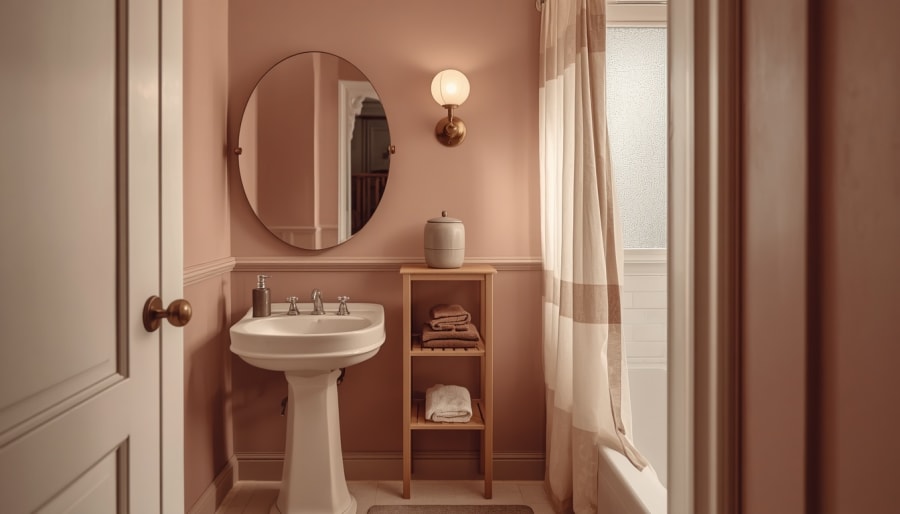
This simple structure prevents the room from feeling as though every object was chosen separately.
Lighting will also change the palette more than most people expect. Cool overhead light can make blush appear gray, cream look flat, and sage feel colder than intended. Before committing to paint or textiles, look at the color in the bathroom during the hours you use it most. A shade that feels serene in daylight may need warmer lighting to keep that same softness in the evening.
Texture matters too.
A smooth painted wall, woven towel, matte ceramic tray, and gently patterned curtain can all share a similar color while still giving the room depth. This is often more sophisticated than introducing another shade simply because the space feels unfinished.
When choosing a bath mat, towel, or shower curtain, use it to repeat the existing palette rather than introduce a completely new one. Repetition is what makes a small bathroom feel composed.
The goal is not to make every surface match. It is to make the room feel as though each color belongs to the same conversation.
Once that relationship is established, even a modest bathroom begins to feel more settled. The fixtures stop looking like separate necessities. The walls, textiles, and small details begin to support one another.
Soft color works best when it does not ask for constant attention.
It should change the way the room feels before the reader can point to exactly why.
Add Vintage Character Without Turning the Room Into a Theme
Vintage character can make a small bathroom feel collected, personal, and far more memorable than a room filled entirely with new, matching pieces.
It can also go wrong very quickly.
When every detail tries to look nostalgic—the mirror, lighting, faucet, artwork, containers, curtain, hardware, and accessories—the room begins to feel arranged around a theme rather than shaped by real life. In a compact bathroom, that visual weight arrives even faster.
A better approach is to let vintage influence appear in a few carefully chosen places.
Start with shape.
A softly curved mirror, scalloped edge, rounded sconce, or framed botanical print can introduce an older visual language without making the room feel dated. Shape is often the gentlest way to add character because it changes the silhouette of the room without adding more objects to the counter.
An oval or arched mirror is especially effective above a small sink. It interrupts the straight lines of tile, cabinetry, and walls while drawing the eye upward. The room feels less box-like, and the mirror becomes a focal point without occupying usable space.
Next, consider finish.
Aged brass, antique bronze, darkened nickel, and warm wood bring depth that polished chrome sometimes cannot. The goal is not to replace every fixture. One repeated finish is usually enough.
A brass-framed mirror paired with a small wall hook may create more cohesion than changing the faucet, light fixture, handles, shelf brackets, and towel bar all at once. Repetition should feel quiet and intentional, not perfectly matched.
Then add something that feels discovered rather than purchased as part of a set.
This might be a small framed landscape, a faded floral print, a miniature still life, or a decorative plate mounted near an empty corner. Artwork gives the bathroom personality without competing for counter or floor space. It also helps the room feel connected to the rest of the home rather than treated as a purely functional zone.
The scale matters.
One medium piece usually creates more calm than a collection of tiny frames. In a narrow bathroom, small objects can quickly become visual confetti. Choose something that can be noticed from the doorway and still leave breathing room around it.
Vintage character also feels more believable when it is balanced by modern restraint.
A decorative mirror looks stronger above a clear sink. An aged metal shelf feels more refined when it holds only folded towels and one practical container. A patterned curtain becomes easier to appreciate when the surrounding palette remains soft.
A compact wall shelf or shallow decorative tray works best when it adds character while also giving everyday essentials a clear place to return to.
The object should earn its place twice: once through beauty, and once through usefulness.
Avoid filling the bathroom with props that require constant arranging. Apothecary jars, ornate perfume bottles, decorative brushes, stacked boxes, and multiple candles may create a beautiful photograph, but they can also make everyday cleaning harder. If an item does not support the routine or hold genuine meaning, it may not deserve space in a room this small.
A helpful rule is to choose one focal vintage element and two quieter supporting details.
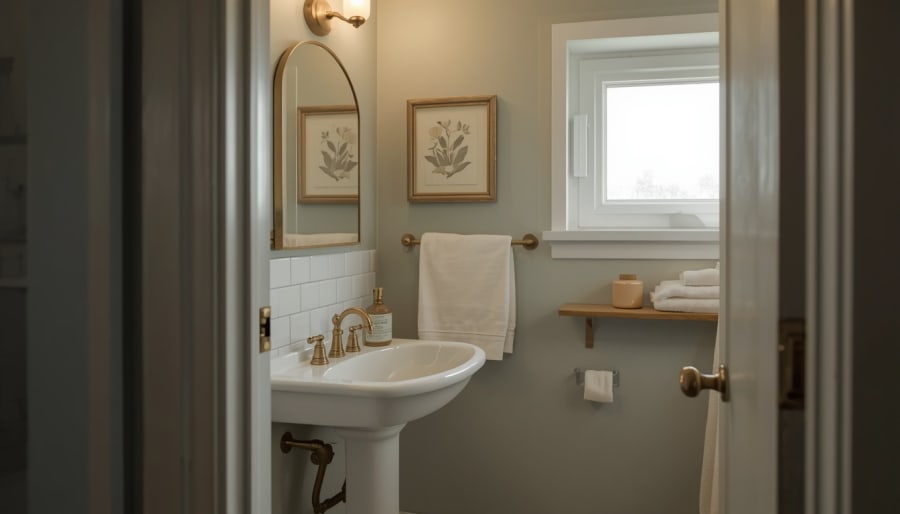
For example:
An arched aged-brass mirror can lead the room. A small framed floral print can echo its warmth. One antique-style hook can complete the relationship.
That is often enough.
The most convincing vintage bathrooms do not feel as though they were recreated from another decade. They feel like modern rooms that have inherited a little history.
Organize Around the Routine, Not the Storage Container
A small bathroom can contain several organizers and still feel difficult to use.
The shelves may be tidy. The baskets may match. Every product may technically have a place. Yet the counter keeps filling, towels remain where they were dropped, and one drawer becomes a crowded collection of items no one can find quickly.
This usually happens when storage is planned around containers instead of behavior.
Before adding another basket, think through an ordinary morning.
Where are you standing when you brush your teeth? Which products do you reach for while the sink is still wet? What do you need immediately after stepping out of the shower? Which items travel between the bathroom and bedroom because their current home is inconvenient?
Those movements reveal more than an empty cabinet ever will.
A useful bathroom is organized in small zones, even when the room is too compact for those zones to feel physically separate.
Create a sink zone for the first and last minutes of the day
The sink area should hold only what is used while standing directly in front of it. Hand soap, toothbrushes, and a small number of daily skincare products may belong here. Hair tools, backup toiletries, medicines, and unopened products usually do not.
Keep the most-used items within one easy reach. If you have to open several containers or move decorative objects before beginning your routine, the system is already asking too much of you.
A shallow tray can create a clear boundary for daily essentials, but it should not become a landing place for everything that enters the room. Leave a little open counter space beside it. That empty area is what makes the arrangement feel controlled rather than crowded.
Build the shower zone around what happens when your hands are wet
Shower storage is often treated as an afterthought, which is why bottles gather along the tub edge or floor.
Keep frequently used products between shoulder and waist height whenever possible. Items stored too high are inconvenient; items kept near the floor are harder to clean around and easy to knock over.
Use one defined holder rather than several small solutions competing across the shower. If the household uses many products, group them by person or routine instead of arranging them only by size.
The towel should also be reachable before you step fully into the room. A hook placed according to the wall’s symmetry may look correct, but a hook positioned where a wet hand naturally reaches will work better every day.
Give the evening routine a quieter home
Nighttime products often need a different system from morning essentials.
A candle, bath soak, face mask, or body lotion does not need to remain on display all day simply because it is part of the bathroom experience. Gather these items in a small basket, drawer, or shelf section that can be accessed together when the pace of the room changes.
This makes the evening ritual feel intentional while protecting the daytime bathroom from unnecessary visual clutter.
Separate active products from backup inventory
One of the fastest ways to overwhelm a small bathroom is to store every replacement beside the product currently in use.
Keep one open shampoo in the shower, not three. One roll of toilet paper may remain close at hand; the rest can move into a cabinet, lidded basket, or nearby closet. Refills, travel sizes, unopened skincare, and cleaning supplies should live away from the most visible surfaces.
The bathroom becomes easier to maintain when active products and household inventory are treated as different categories.
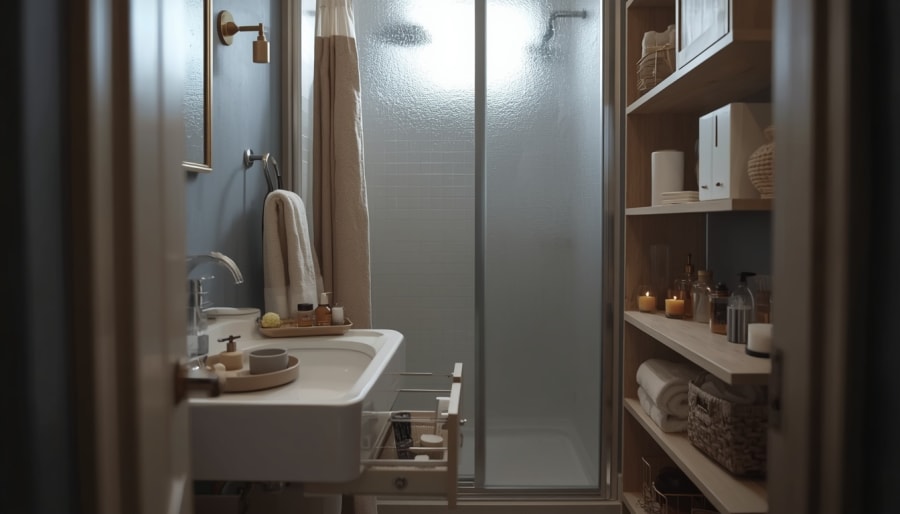
Deep under-sink space is often where useful products disappear behind pipes, half-empty bottles, and bulky refills. A slim pull-out organizer or compact drawer can make that awkward area easier to see and reach, especially for backup toiletries and occasional-use items that do not belong on the counter.
Use vertical space carefully
Walls can relieve pressure from the sink and floor, but every open shelf adds another surface that must remain visually controlled.
Place open storage where it serves a clear action. A shelf near the shower may hold folded towels. A narrow ledge beside the mirror may support one daily product zone. Hooks behind the door can hold robes or cleaning cloths without entering the room’s main sightline.
Avoid using every available inch simply because it is empty. In a small bathroom, unused wall space can be part of the design.
Make returning items easier than leaving them out
The best organization system is not the one that looks most impressive immediately after styling. It is the one that still makes sense when you are tired, running late, or cleaning quickly.
A drawer that sticks, a basket with a difficult lid, or a shelf that requires reaching behind other objects will eventually be abandoned. Choose placements that allow items to be put away with one simple motion.
When the right home is also the easiest home, the bathroom begins to reset almost by itself.
That is the difference between storage and organization.
Storage gives objects somewhere to go.
Organization makes returning them there feel natural.
Let Lighting Change the Mood Before Decor Does
A bathroom can have the right color palette, carefully chosen vintage details, and a beautifully organized counter—and still feel cold the moment the light is switched on.
Lighting has that much influence.
In a small room, one bright ceiling fixture often touches every surface at once. It flattens soft colors, exaggerates product labels, throws shadows beneath the eyes, and makes the bathroom feel more practical than personal. Even a warm blush wall can appear gray under cool light. Cream towels may lose their softness. Aged brass can look dull instead of gently reflective.
Before adding more decor, look at what the existing light is doing.
Stand in front of the mirror during the time you usually get ready. Notice whether the light reaches your face evenly or falls mostly from above. Check the corners of the room. Are they softly shadowed, or do they disappear into darkness? Then return in the evening. Does the bathroom feel calmer when the rest of the home is dim, or does the same bright fixture make it feel disconnected from the mood outside the door?
The goal is not to make the bathroom permanently dark. It is to give the room more than one way to feel.
Keep practical light close to the mirror
The most useful bathroom light is not always the brightest one. It is the light placed where the task happens.
Lighting above the mirror can work well when it spreads downward evenly, but a single harsh bulb directly overhead often creates deep shadows. Two small fixtures beside the mirror can feel more balanced, while one softly diffused sconce above an arched or oval mirror can be enough in a very narrow bathroom.
The fixture does not need to be ornate to support a vintage mood. A rounded shade, aged-metal base, or softly opal glass can bring warmth without making the wall feel busy.
What matters most is the quality of the glow. Choose light that feels warm and clear rather than amber, orange, or overly blue. The bathroom should still be practical for skincare, makeup, shaving, and cleaning. Warmth should soften the room, not distort it.
Let the ceiling light support, not dominate
Many small bathrooms rely on one ceiling fixture because there is little room for anything else. That fixture can remain useful, but it should not have to carry every moment of the day.
A diffused cover can feel gentler than exposed bulbs. A simple flush mount with a warm finish can visually connect to brass or bronze details elsewhere in the room. If the existing fixture cannot be replaced, changing the bulb temperature or adding a dimmer may make a more noticeable difference than another decorative accessory.
The room should feel evenly visible without looking washed out.
Create a separate evening atmosphere
Evening light does not need to illuminate every bottle, shelf, and corner.
When the day slows down, switch off the brightest source and allow one smaller glow to define the room. This may come from a wall sconce, a dimmed ceiling light, a rechargeable lamp placed safely away from water, or a candle used with care on a stable surface.
A small candle beside the tub or sink can add warmth, but its real value is not decorative. It creates a visual cue that the room has shifted from preparation to rest.
Keep the arrangement restrained. One flame reflected in a mirror or against a pale wall often has more emotional impact than several candles competing across the room.
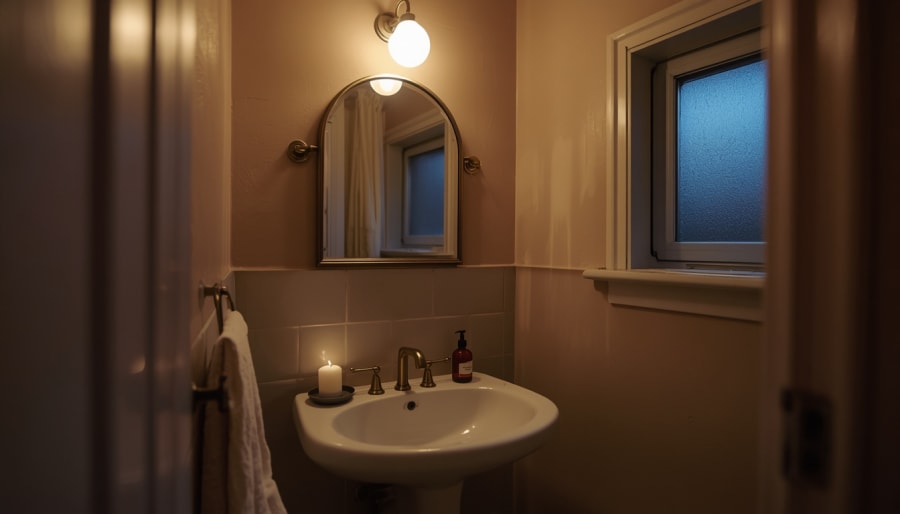
Use reflection to make soft light travel farther
Mirrors, pale tile, glazed ceramic, and warm metal can extend light through a compact bathroom without adding more fixtures.
A sconce reflected in an oval mirror may softly brighten the opposite wall. A matte cream tray can catch a small amount of glow without creating glare. Aged brass introduces gentle highlights that feel warmer than polished chrome.
This is one reason lighting and material choices should be considered together. The room does not need more brightness everywhere. It needs light to land on the right surfaces.
Make the mood easy to repeat
A calming bathroom should not require a complicated setup every night.
Keep the evening light source accessible. Place the candle where it can be used safely without moving several objects first. If a lamp needs charging, give the charger a predictable home. If a dimmer is available, use a level that still allows the room to function comfortably.
The best atmosphere is the one you can create in a few seconds.
When lighting is handled thoughtfully, the bathroom begins to feel different before anything else changes. The walls appear softer. The mirror feels less severe. The smallest details become easier to notice.
And a room that once felt purely functional starts to hold a quieter part of the day.
Bring in Softness Where the Body Actually Feels It
A bathroom begins to feel cozy when comfort is no longer limited to what the eye can see.
It is the towel you reach for with wet hands. The surface beneath your feet when you step away from the shower. The robe that is close enough to wrap around you before the room feels cold. These small points of contact often shape the experience of a bathroom more than another framed print or decorative jar ever could.
In a compact room, textiles need to do more than add color. They must absorb well, dry properly, fit the available space, and return easily to order.
Start with the towels used most often.
A hand towel should feel pleasant, but it also needs enough space to dry between uses. When several thick towels are layered on one narrow ring or hook, they remain damp longer and quickly make the bathroom feel untidy. A smaller number of well-placed towels usually creates more comfort than an overflowing stack.
Keep one fresh hand towel near the sink and give used bath towels enough separation to breathe. In a shared bathroom, individual hooks can work better than one crowded bar because each towel has a defined place and can be returned with one simple movement.
The placement should follow the body.
A towel beside the sink should be reachable without dripping across the floor. A bath towel should sit close enough to the shower that you do not need to step fully into the room before reaching it. A robe hook can be placed behind the door or on an underused wall, but only if it remains convenient when the door is open.
Softness becomes meaningful when it removes a small discomfort from the routine.
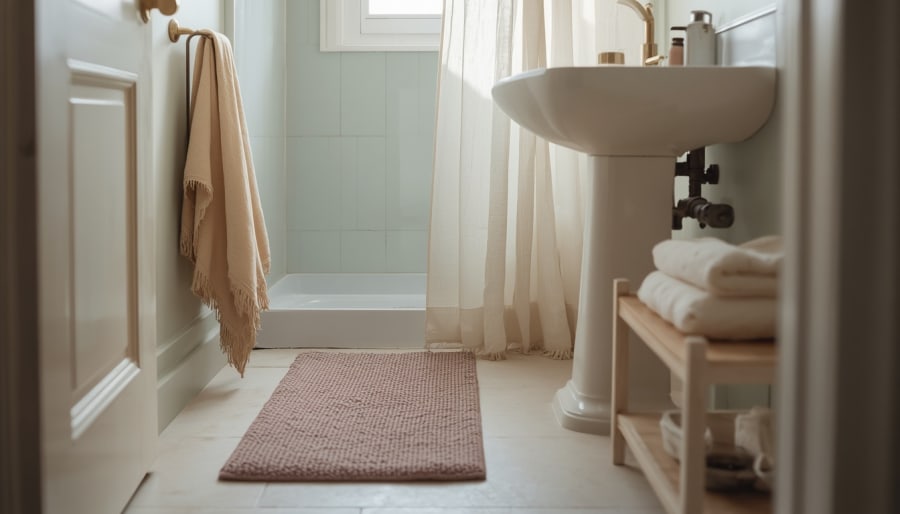
Soft cotton hand towels work best when their color quietly repeats the room’s main palette instead of introducing another competing accent.
Choose a tone that settles into the room: warm white against blush walls, muted cream beside sage, or soft gray-blue in a bathroom built around weathered brass and pale wood. Matching every textile exactly is unnecessary. What matters is that they feel related.
Then consider the floor.
A bath mat or narrow runner can warm a cold surface and soften the acoustics of a small bathroom, but scale is important. A mat that crowds the toilet base, catches beneath the door, or extends into every walking area will make the room feel smaller and become difficult to keep dry.
Measure the clear floor space rather than choosing by appearance alone. The best mat leaves a visible border of flooring around it and sits exactly where bare feet naturally land.
Texture should feel comforting without becoming difficult to maintain. Deep, plush piles may look luxurious, but in a small, frequently used bathroom they can hold moisture and collect lint. A lower-profile woven or chenille surface may be easier to dry, shake out, and return neatly to place.
The same restraint applies to displayed towels.
Stacks can add warmth to an open shelf, but only when the towels are genuinely used and the shelf has enough room around them. Three folded towels with breathing space will feel calmer than eight compressed into a decorative tower.
Think of textiles as part of the room’s rhythm.
Fresh towels enter. Used towels need somewhere to dry. Bath mats become damp. Laundry leaves the room. When every soft item has a clear next step, the bathroom remains comfortable without becoming difficult to maintain.
This is where coziness becomes believable.
Not through layers added for a photograph, but through everyday materials that make the room gentler each time you use it.
Add One Sensory Detail That Changes the Room
Once the bathroom is calmer, better organized, and more comfortable to use, there is often a temptation to keep adding.
Another jar. Another framed print. Another candle. Another basket to fill the last empty corner.
But the final layer of a cozy bathroom should not make the room look fuller. It should make the experience feel deeper.
This is where one sensory detail can do more than several decorative objects.
Scent is often the most immediate choice, but it works best when it feels connected to the room rather than applied over it. Clean herbal notes, soft wood, gentle citrus, eucalyptus, or a restrained vanilla can support a bathroom without making it feel perfumed. The goal is not to create a constant fragrance cloud. It is to give the room a subtle identity that becomes noticeable when you enter.
Choose one scent direction and let it remain consistent.
A candle, a fresh bundle near the shower, or a lightly scented soap may be enough. Combining several unrelated fragrances can make a small bathroom feel heavy, especially when steam intensifies them.
Greenery can create a similar effect through color and movement.
A small eucalyptus bundle, one trailing stem, or a single leafy branch can soften the hard surfaces found in bathrooms—tile, mirrors, porcelain, and metal—without requiring a large plant collection. The irregular shape of a branch introduces something organic into a room otherwise built from straight edges and fixed fixtures.
Scale remains important.
A large arrangement can overwhelm a pedestal sink or narrow shelf. A few stems placed in a simple vessel usually feel more believable and are easier to move when cleaning.
A small bundle of eucalyptus stems works especially well when it is treated as one quiet natural gesture rather than another decorative arrangement competing for attention.
Place it where the room can benefit from softness but where it will not interfere with the routine. Near the shower, it can visually connect with steam and water. On a slim shelf, it can break up a row of folded towels. Beside the mirror, it can soften the reflection without taking over the sink.
Natural texture can also bring warmth when fragrance or greenery is not practical.
A woven basket, pale wood shelf, linen-look curtain, or matte ceramic vessel adds depth without introducing another color. These materials help a small bathroom feel less clinical because they absorb light differently from glossy tile and polished metal.
The key is restraint.
Choose one primary sensory element and let the other details support it. If eucalyptus is the focus, keep the vessel simple and the surrounding shelf mostly clear. If scent is the focus, avoid displaying several candles and diffusers at once. If texture is the focus, repeat it quietly in two places rather than introducing five different natural materials.
The room should still have visible breathing space around the sensory detail, allowing the reader to notice it as a mood-setting moment rather than part of a crowded display.
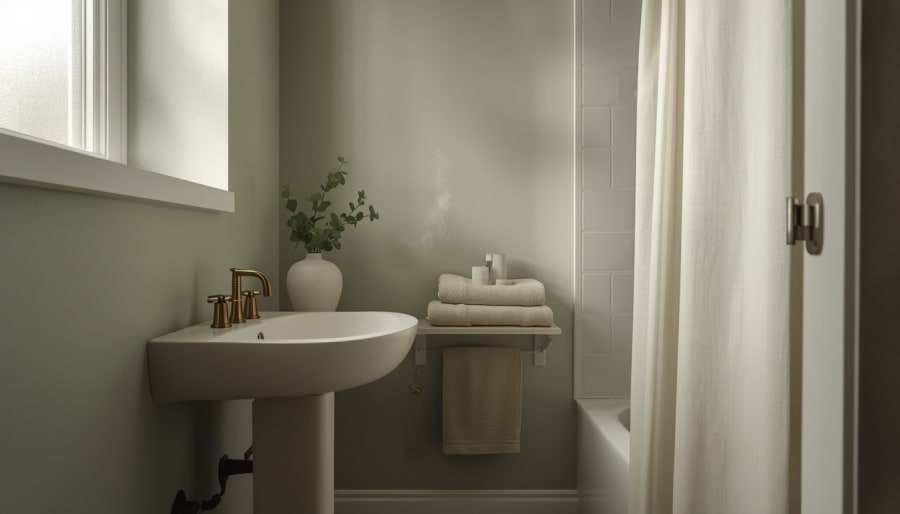
A small bathroom does not need to imitate a spa to feel restorative.
It needs one detail that slows the eye, softens the atmosphere, and makes an ordinary routine feel a little more intentional.
That is often where the room begins to feel personal.
Design the Reset Into the Room
A bathroom does not stop being lived in simply because it has been styled well.
Water lands around the sink. Towels become damp. Bottles migrate from their assigned places. A bath mat shifts slightly each time someone walks across it. Even the calmest room begins to lose its shape when the routine is busy.
That does not mean the design has failed.
A successful bathroom is not one that remains untouched. It is one that can return to order without requiring a full cleaning session every time it is used.
The easiest way to maintain a small bathroom is to build the reset into the room itself.
Begin with the surfaces that control the first impression.
In a compact bathroom, the sink counter, toilet lid, floor, and visible shelf are often understood in one glance. When these areas are clear, the entire room feels calmer—even if a drawer or cabinet is not perfectly organized.
Give the counter a simple closing routine. Return daily products to their tray or drawer. Wipe away standing water. Straighten the hand towel. These actions take less than a minute when every item already has a nearby home.
Do not aim for perfection after every use. Aim for a room that is ready for the next person.
Textiles need their own reset.
A towel cannot remain soft and inviting if it is folded while damp or layered beneath another towel. Hang bath towels with enough space to dry. Lift the mat after a particularly wet shower if moisture gathers underneath it. Move used washcloths directly to a small laundry basket instead of allowing them to collect beside the sink.
This prevents the bathroom from developing the heavy, slightly damp feeling that no candle or fragrance can disguise.
The same principle applies to shower products.
Once or twice a week, remove empty bottles, rinse the holder, and return only what is currently being used. The shower should not become a storage area for nearly finished products, samples, and backups simply because they are already wet.
A small room benefits from frequent light editing more than occasional dramatic decluttering.
Create one weekly moment to restore the details that are easy to overlook. Refill hand soap. Replace the hand towel. Wipe the mirror. Shake out the bath mat. Check whether a new product has entered the room without being given a permanent place.
This is also the right time to notice whether the system is still working.
If the same bottle keeps appearing on the counter, its assigned home may be inconvenient. If towels are always left on the door, the existing hook may be too far from the shower. If a basket constantly overflows, it may be holding more categories than it can realistically manage.
Do not blame the habit before questioning the placement.
The bathroom should adapt to the people using it—not demand that they perform a perfect routine every day.
Keep cleaning supplies simple and accessible enough that small messes can be handled before they become a larger task. A cloth near the vanity, a discreet shower squeegee, or one clearly defined cleaning area can make upkeep feel less separate from daily life.
Avoid storing so many supplies in the bathroom that the cleaning system becomes clutter itself. Only the products used regularly need to remain nearby. Everything else can live with the household inventory outside the room.
The most comforting version of this bathroom is not the one captured immediately after styling. It is the one seen on an ordinary evening—towels drying properly, the counter mostly clear, the light softened, and every useful detail ready to support the next quiet routine.
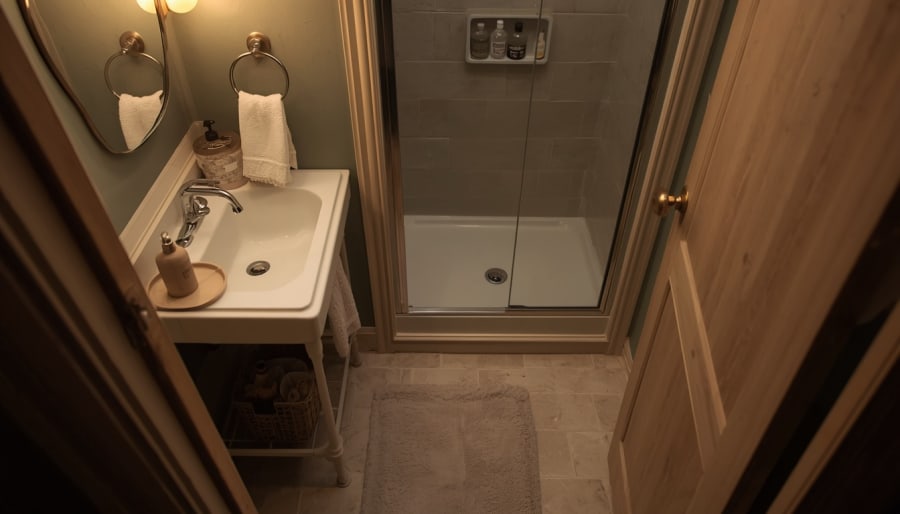
That is what makes the transformation last.
Not a perfect arrangement preserved for a photograph, but a room that can absorb real life and still find its way back to calm.
Let the Bathroom Feel Personal, Not Perfect
Pinterest can help you recognize what you are drawn to.
Perhaps it is the softness of blush walls, the curve of an antique-inspired mirror, the quiet warmth of brass, or the way a folded towel and a small branch can make an ordinary sink feel considered.
Inspiration becomes less helpful when it turns into a checklist.
A bathroom does not need every element from a saved image to create the same emotional effect. The room in that photograph belongs to a different home, with different light, proportions, storage, and routines. Copying it piece by piece may reproduce the objects without recreating the feeling.
The strongest bathroom refreshes leave room for the person who lives there.
That may mean keeping the practical medicine cabinet even if an open vintage shelf looks prettier online. It may mean choosing washable textiles instead of delicate ones, adding an extra hook for a child’s towel, or leaving enough empty counter space for a partner’s morning routine.
These decisions are not compromises that weaken the design.
They are what make the design believable.
Personal character does not require a collection of decorative objects. One familiar detail can be enough: a small piece of artwork you genuinely enjoy, a ceramic dish brought home from a trip, an old wooden frame, or a color that appears elsewhere in your home.
The item should feel connected to your life rather than selected only because it matches the bathroom.
This is especially important in a small space. When every visible object carries a purpose or a quiet sense of familiarity, the room feels layered without becoming crowded.
Allow a little imperfection to remain.
A folded towel does not need hotel-sharp edges. Eucalyptus stems can lean naturally instead of forming a symmetrical arrangement. The candle may sit slightly off center on the tray because space is needed for hand soap. A vintage frame may show a little age.
These details keep the room from feeling frozen.
They remind us that comfort is not the same as visual perfection.
A cozy bathroom should also reflect the rhythm of the household. A busy family bathroom may need more hooks and fewer display pieces. A guest bathroom may benefit from clearly visible towels and an uncluttered surface. A private bathroom can hold more intimate rituals—a favorite body lotion, evening candle, or artwork that feels restful to you alone.
The right design is the one that makes the routine feel more natural for the people using it.
Seen from the doorway, the finished bathroom should not look as though every surface was arranged for a photograph. It should feel quietly settled: soft color in the background, vintage character appearing in a few thoughtful details, everyday essentials held in order, and enough openness for real life to continue.
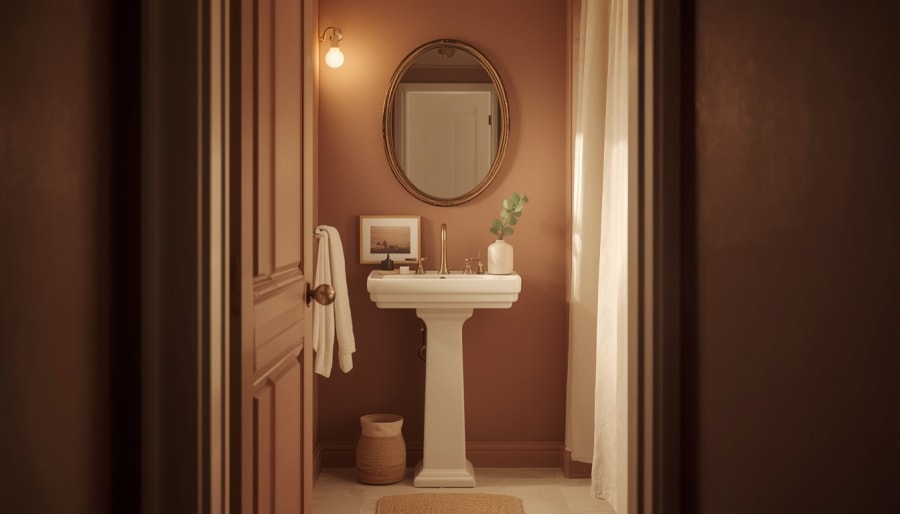
That balance is what gives a small room emotional depth.
It no longer feels like a collection of ideas borrowed from somewhere else.
It feels like part of your home.
A Small Bathroom Can Still Hold a Full Sense of Comfort
A small bathroom may never offer endless counter space, a deep freestanding tub, or the effortless openness seen in a professionally styled interior.
It does not need to.
The most meaningful transformation happens when the room begins to support the way you actually live.
The counter becomes easier to clear because daily essentials have a defined home. Soft color creates continuity instead of visual noise. One vintage detail gives the room character without turning it into a theme. Towels are placed where the body naturally reaches for them. Lighting shifts with the time of day. A quiet scent, natural stem, or familiar piece of artwork makes the space feel emotionally yours.
None of these changes depends on pretending the bathroom is larger than it is.
They depend on noticing what the room asks of you each day—and responding with a little more care.
That may mean removing more than you add. It may mean choosing one warm finish instead of replacing every fixture. It may mean leaving a portion of the wall empty, allowing the sink counter to breathe, or accepting that a practical hook belongs exactly where it is most useful rather than where it looks most symmetrical.
These decisions are small, but they change the feeling of the room repeatedly.
Every morning becomes less scattered. Every evening carries a softer transition. Cleaning becomes easier because the space is not crowded with unnecessary layers. The bathroom begins to feel intentional without becoming precious.
The finished room should feel calm when you enter, useful while you are there, and easy to leave in order—a compact retreat shaped not by luxury, but by thoughtful attention to the ordinary moments that happen inside it.
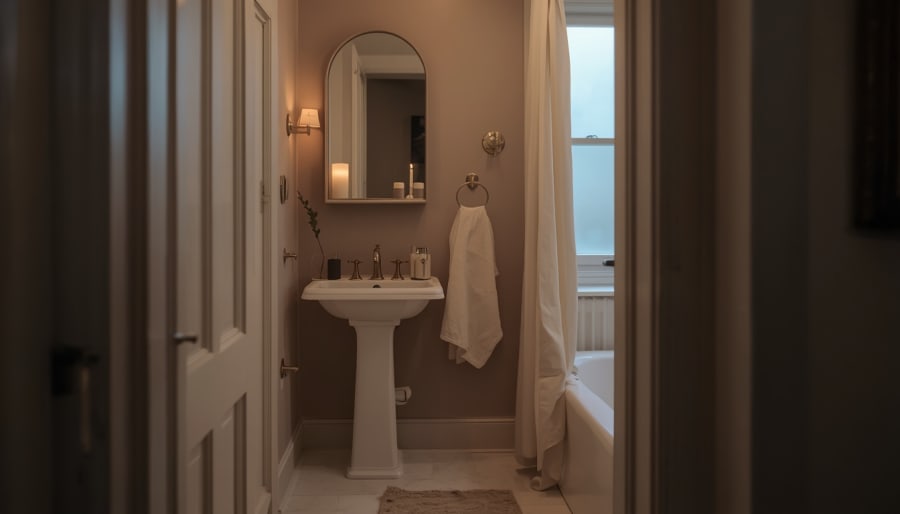
That is the real promise of a cozy bathroom.
Not escape from everyday life, but a gentler place to move through it.
Editor's Note
A small bathroom does not become comforting because every surface has been styled or every practical item has been hidden. The most successful spaces usually feel better because they ask less of the person using them. The towel is within reach. The counter has room to function. The lighting does not feel punishing at the end of the day. The colors support one another, and the few decorative details that remain have enough space to be noticed. That is why this kind of refresh should happen slowly. Start with the friction you feel most often. If the sink is always crowded, solve that before choosing artwork. If towels never dry properly, rethink the hooks before buying another set. If the room feels cold at night, adjust the light before adding more decor. One thoughtful correction will usually change the bathroom more than several unrelated purchases. Vintage character, pastel color, eucalyptus, candles, and soft textiles can all make the room feel beautiful—but only when they support the routine rather than compete with it. The goal is not to recreate someone else’s bathroom. It is to notice what would make your own morning easier, your evening quieter, and the room a little more pleasant to return to every day.
Curated Finds
Shop This Style
A few thoughtful pieces chosen to support the mood, function, and everyday rhythm of this space.
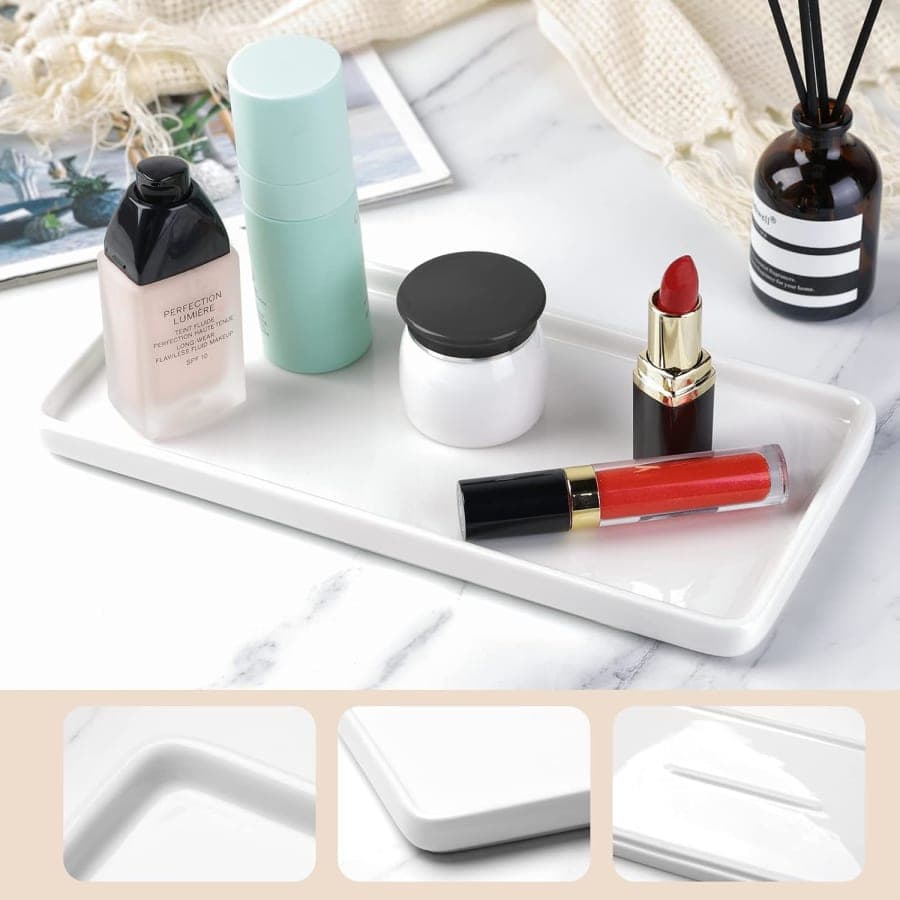
For Counter Order
White Ceramic Vanity Tray
Keeps a few daily essentials neatly contained without crowding a compact bathroom counter.
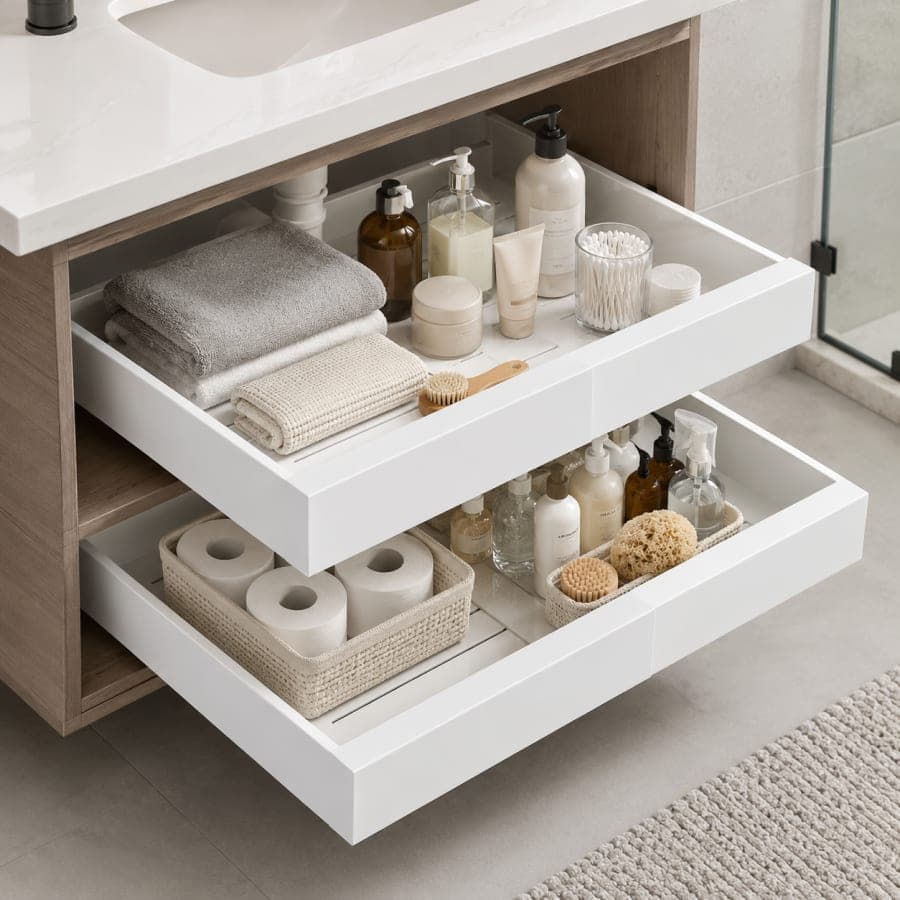
For Hidden Storage
White Pull-Out Cabinet Organizer Drawers
Makes under-sink essentials easier to see, reach, and return without adding clutter to the bathroom counter.
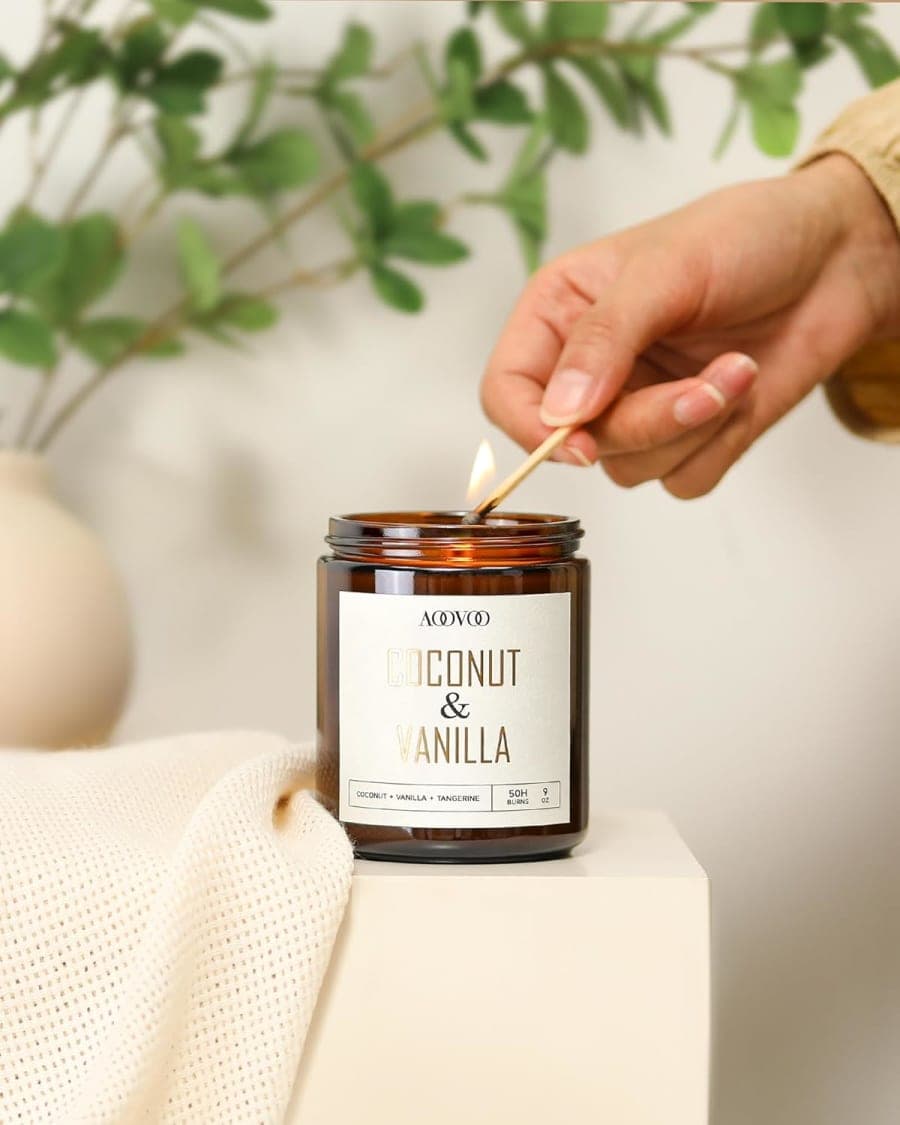
For Evening Calm
Coconut Vanilla Soy Candle
Adds a soft glow and creates a gentler transition from everyday routines into a calmer evening mood.
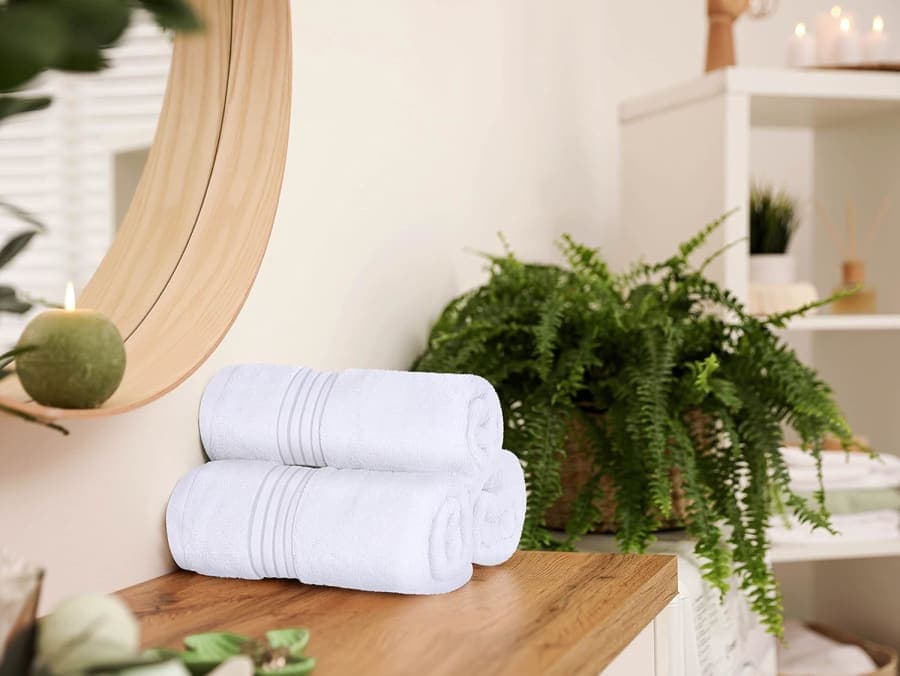
For Everyday Comfort
Soft Cotton Hand Towels
Adds a softer touch to daily routines while quietly repeating the bathroom’s warm, calming color palette.
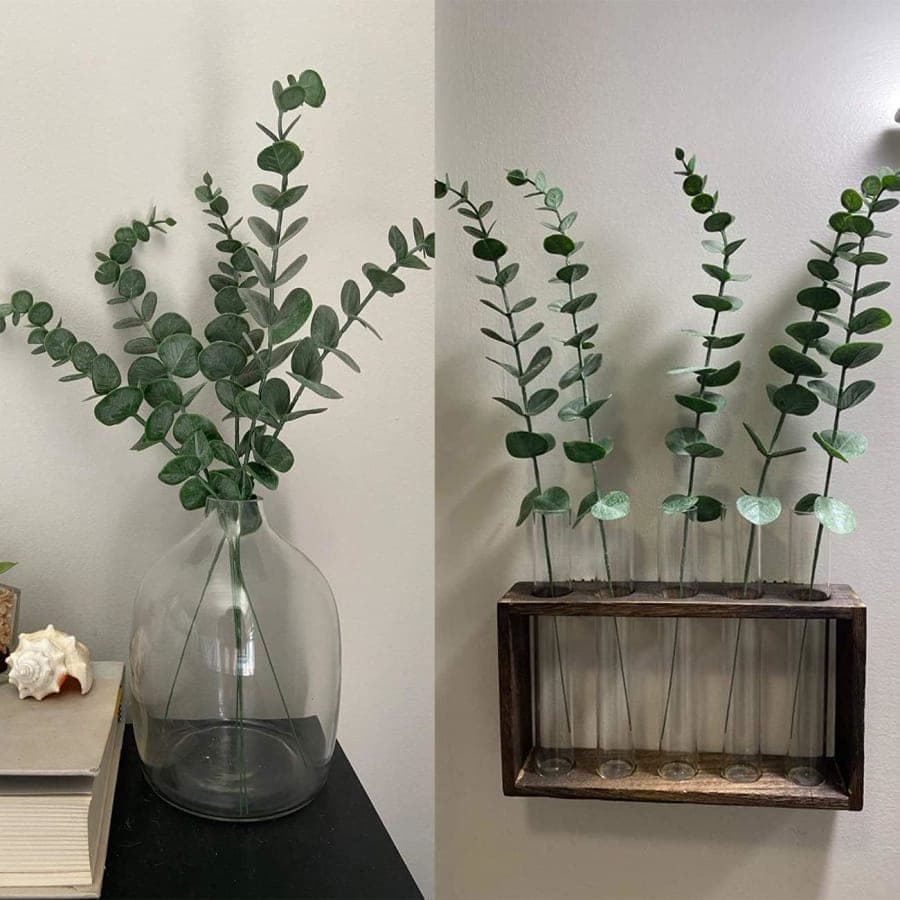
For a Natural Touch
Real Touch Eucalyptus Stems
Adds one quiet layer of greenery that softens the bathroom without making the space feel overly decorated.

VibeHaven Editorial
Thoughtful notes for creating a home that feels calm, useful, and warmly lived in. We look for simple styling choices, quiet organization ideas, and everyday pieces that add beauty without visual noise.
Category
Bathroom Inspiration
Read Time
8 min read